Showing posts with label exhibits. Show all posts

Sunday, October 26, 2014

Online Exhibit: From Baby Caps to Mourning Rings

If you have been in or around Boston this month, you have likely heard about the time capsule in the lion's head on the Old State House. The Old State House is the oldest surviving public building in Boston. It was built in 1713 as the seat of Royal government. It was the site of the Boston Massacre, which helped incite the colonists against the British and lead to the American Revolution. Although the loin and unicorn adorning its front were symbols of the British Empire, they were preserved even after the King was ousted from the former colonies.


The Old State House is currently undergoing preservation, and the lion and unicorn taken down for conservation. A1901 newspaper article alluded to the fact that a time capsule had been placed in the lion's head the last time the animals were conserved and that article was just proved correct. Earlier this month, conservators removed a lead box from the head. It is filled with books, newspapers and letters from local politicians. A full list and a glimpse of the contents is available here. When the lion goes back up on the State House, a new time capsule will be inside.


The Old State House is owned by the Bostonian Society, a private organization "...dedicated to studying, and preserving Boston’s uniquely important history, embodied in materials, records, and structures such as the Old State House, and in sharing an understanding of the revolutionary ideas born here." Because the Old State House is on the Freedom Trail, they get millions of visitors each year and they do a nice job of interpreting Boston's history.


Looking for information about the lion's head time capsule, I was recently on their web site and discovered a lovely exhibit of Boston artifacts titled, From Baby Caps to Mourning Rings: The Material Culture of Boston's 18th-Century Girls and Women. It is a collection of intimate objects owned by women during the Revolution, including caps, dresses and school girl embroideries among other artifacts. The exhibit is set up around a clock face symbolizing both the hours of the day and a single lifespan. I suggest that you begin at 7 o'clock and work you way around the face of the clock. Some of the embroideries are simply stunning. The baby caps and the embroidered map of Boston were my favorites. I was grateful that it was easy to enlarge the photos and that when enlarged they were so crisp.


There is just enough text to wet an appetite to learn more about Revolutionary life and it makes me want to know what else may be in Bostonian Society's holdings. Although I worked right next door when I was with the National Park Service in Boston (you can see the brown NPS sign to the left of the Old State House in the photo) I assumed wrongly that the collection was mostly political papers. I'm thrilled that they are sharing these treasures over the internet and I think you will be too.

Photo from: http://www.usatipps.de/bundesstaaten/neuengland/massachusetts/boston/


Wednesday, March 5, 2014

Exhibits at Winterthur: Whose Your Daddy and Costumes of Downton Abby

I am blessed to live in two major metropolitan areas where I can easily visit some spectacular museum exhibits, but if you are like me, there are always more exhibits that you wish you could have seen, but couldn't get to, or didn't know about.


Recently, while browsing the Winterthur Museum website I saw that they have online exhibits providing additional resources on their special exhibitions. Winterthur, in Delaware, is the premier museum of American decorative arts. Founded by Henry Francis du Pont, it holds over 90,000 objects made or used in the United States between 1640 and 1860. The collection is housed in the du Pont family home and has tons of online resources for researchers.


"Who's Your Daddy" was an exhibit that ran from October 4, 2008 through May 17, 2009 and explores family relationships in needlework. The exhibit includes samplers, gorgeous knit purses and even scraps of fabric from Martha Washington's dresses. The online exhibit includes a short video providing information about select pieces in the Winterthur collection and an exhibit catalog. I wish the catalog was a little better quality--maybe it is if you print it out, but I couldn't enlarge the photos to see the details. Even so, the text was fascinating--and I enjoyed the video. I'd be grateful for any links people may have to other online exhibits around the world. It is a great way to get to know a collection, even if you can't visit right away.


Also, exciting news for all the Downton Abby fans! March 1, 2013 through January 24, 2015 Winterthur is showcasing an exhibit of 40 Downton Abbey dresses. If you are like me and watch primarily to see what Lady Mary and Edith will wear next (I literally was hyperventilating at some of the hats from the first season), it is not to be missed. Let's hope they have a corresponding online exhibit in the future. My husband wants us to take a holiday this year. I wonder if I can persuade him that Delaware is the place he wants to be?!

Sunday, September 29, 2013

The crochet coral reef project

Last weekend I went back to the Denver Art Museum to see the the Crochet Coral Reef before it was taken off exhibit. I thought it was the work of the Ladies Handiwork Society out of Denver, but in fact, the story of its creation is much more fascinating than yarn bombing.

The crochet coral reef stretched out for 20' in a rainbow of color.


The project is sponsored by the Institute For Figuring, a non-profit Los-Angeles based organization, to bring awareness to the world's oceans and engage the public in science, math, environmental issues and crafting. That's a lot of pressure to put on a lowly crochet hook, but its working. The Crochet Coral Reef has been displayed around the world and has inspired satellite reefs from Chicago to Dublin to Australia.


It was conceived by two transplanted Australian sisters who got hooked, quite literally, on math. Inspired by the Great Barrier Reef, they began experimenting with a technique called hyperbolic crochet, discovered by Dr. Daina Taimina at Cornell University in the 1990s, to develop algorithms for making all sorts of coral creatures. Prior to Dr. Taimina's discovery, it was thought to be impossible to represent hyperbolic space, a type of non-Euclidian geometry, with three-dimensional objects. More information on hyperbolic crochet and the project inspiration can be found on the Crochet Coral Reef Project website and in the project book, An Exploration of the Intersection of Higher Geometry and Feminine Handicraft, by Margaret Wertheim. The book includes directions for crocheting hyperbolic objects. It is available for $20 on the Institute For Figuring website.

A close up of a portion of the reef shows the variety of shapes and colors in the reef.


What is especially fun about this project is that in addition to displaying the reef, The Institute For Figuring encourages public participation in crocheting new pieces of reef so that it continues to grow. There was a representative at the DAM teaching visitors how to crochet using this technique and explaining how the stitches created the shapes of hyperbolic space.


When the exhibit leaves Denver this month, it is going to Copenhagen, Denmark. You can see it there or encourage your local institution to host a showing by contacting the Institute.


I was fascinated by the colors and forms of this project before I learned about the math and science behind it. It seems that the crochet hook may not be so lowly after all.

These yarn jellyfish made me laugh.


Small cases showed separate, reef-inspired works.


The beaded coral is stunning.


This piece really showcases the hyperbolic shapes.


Sunday, September 15, 2013

Dyeing fun at the DAM

Saturday I took advantage of a break in the rain to visit the Denver Art Museum. Since May, they have celebrating the opening of their new permanent textile exhibit by highlighting textiles throughout the museum and hosting textile-related events. I'm ashamed to say that I didn't see many of the exhibits because I was having so much fun on the first floor. It was almost as much fun as being in grammar school again!


Before I even got inside, I found the entrance plaza transformed into a dye garden, which highlighted dye plants and plant based dyes, and hosted demonstrations of both plant-based dyeing techniques and silk painting. I arrived by 10 and this area was full of people each time I walked by until I left at 1:30. What a great way to pull people into the museum!

In the dye garden, you could also sign up for indigo dying. Hoping it wasn't just for kids, I signed up--and wouldn't you know it, there was only one child and I even found a coworker and his wife participating! I have never dyed anything, so tie dyeing an indigo bandana was a lot of fun. First we bunched and folded our bandanas and held them fast with rubber bands. After we finished, the bandanas soaked in water for a few minutes before being plunged into the dye bath for five minutes. After the dye bathe, the bandanas were rinsed, then we undid the rubber bands to see our creations.


The volunteer staff then took over to wash our creations and store them for us to pick up on our way out. They really had the whole process down so that it took no more than 30 minutes. Here is my bandana. It looks like an underwater scene. Maybe I can give some of those blobs tentacles and see what happens!


Upstairs while I was waiting for a tour of the new exhibit (which I missed) I got engrossed in the quilt studio where they had quilts set up for a kind of community wide quilting bee, tables to make crazy quilt blocks on, and Saturday's speaker, which was a local artist explaining how to dye fabric. I thought her talk was fascinating, and then I found out that we could try dyeing ourselves. Using stamps, relief plates, brushes and rollers we used thick fabric dye to dye our own cotton squares. Honestly, I thought I was 8 again. What a lot of fun! I will have to go to her art studio next week to pick up my finished square after it has been processed. The studio is around the corner from the museum. I stopped there before going home and got list of dyeing and sewing classes they offer. I'm hoping I can take a class soon.


So I didn't see many of the exhibits, but I have one more weekend before the textiles (except for the new permanent exhibit) are packed up, so I may go back this week to see a few additional things. For example, I know that the Ladies Fancywork Society, Denver's local yarn bombing group, has a coral exhibit that I would like to see before it moves out. Here is a sneak peak from a small case on the first floor of what it is like.


And here is their contribution to the museum's back entrance. Aren't these ladies talented?


So maybe I will feature more next week. Until then, I've found a lot of great new resources on learning dyeing techniques in Denver and I can't wait to explore the world of fabric dyeing.


Wednesday, July 24, 2013

Fun in Fort Collins

Over the weekend, my husband and I went to Fort Collins, CO. He always wants to go there when he visits, but my car isn't air conditioned and an hour long drive in 100 degree weather isn't something to look forward to. This trip, however, I really wanted to go because one of my favorite fabric artists, Sally Mavor, had a piece exhibited at the Lincoln Center.

You can find out how Sally made this 3-D piece on her blog at the link above.


The Birds of BeeBe Woods was inspired by the woods of Falmouth, MA. I love the piece so much that I bought a poster of it several months ago, and I couldn't wait to see it in real life. Rightfully, it won the Juror's Choice award. In fact, every person who came into the exhibit while we were there did a beeline for the piece, oohing and ahhing from all the way across the room.


Up close, the piece, done on embroidered felt, is masterful. I thought my poster showed the details, but seeing how tiny and even her stitches were, for example across the wren's wing, was flabbergasting. It is a perfectly delightful work of art and is on display in Fort Collins through August 31. I'll write more about the wonderful quilts that we saw there later!

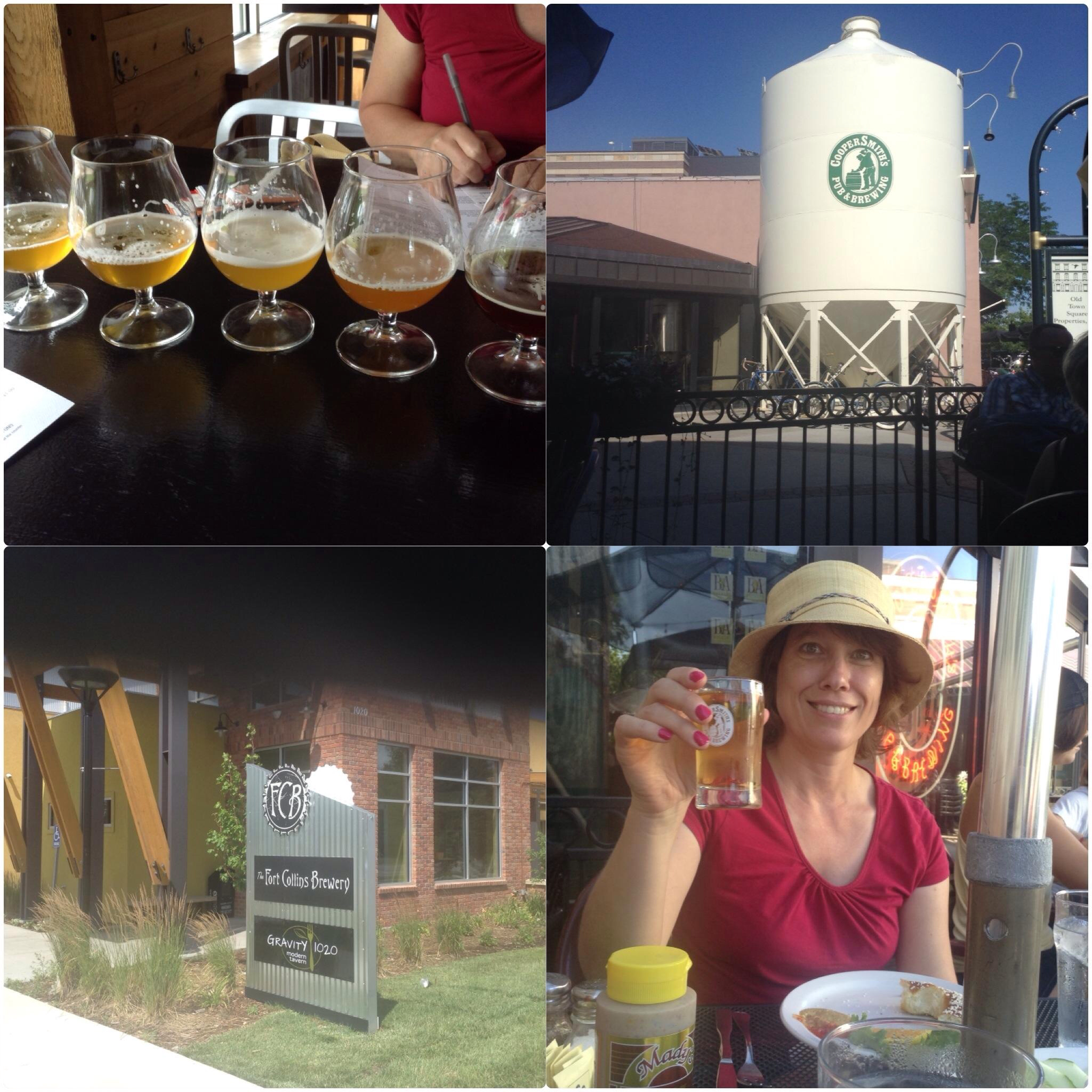
Green chili beer. YUM!


In between samples of craft beer (Fort Collins hosts 10 craft breweries) we also stopped by to see LambSpun--the Fort Collins knitting shop made famous by the mystery novels of Maggie Sefton. Boy was my mom excited to see photos! It is a lovely shop and there was an afternoon tea & stitch going on while we were there. Roger didn't take a photo, but seeing all the knitters sitting at the big wooden table gabbing away while they knit was just like the books!

Finally here is some eye candy I saw at one of the Fort Collins shops--every sewing room needs one!

This clock made by Allen Designs really caught my attention. It is so whimsical!


All in all, it was the perfect marriage of both our interests and I saw a lot to inspire me.


Wednesday, June 12, 2013

To Boston with love

My recent sojourn to Boston is over, but while I was there, my husband and I went to the Museum of Fine Arts (MFA) to see an exhibit of prayer flags sewn by people all over the world and sent to Boston to provide hope after the Boston Marathon bombings in April. The exhibit, called "To Boston With Love", is on view through July 7.

Prayer flags come from Buddhist tradition. Special practitioners paint prayers onto the flags, which are then strung together and left outside to flutter in the breeze and send the prayers heavenward. The idea to send healing prayers to Boston in the wake of the explosions came from Berene Campbell of Vancouver, Canada, who worked with Amy Friend of West Newbury, Massachusetts to bring it to fruition extremely quickly. The project was publicized and organized by the Vancouver Modern Quilt Guild whose web site provided directions and ideas for making prayer flags and whose members took on the responsibility of gathering flags from around the world and getting them to Boston in time for Memorial Day

I first heard of the project through Faye C. on Stichin' Fingers, a social networking site for embroiderers. Believe it or not, she lives in Australia! It was strange, but gratifying to hear of something going on in my own backyard from someone all the way around the world. She made some lovely prayer flags to hang at her home, and posted the project web site so that people could participate. Unfortunately, I heard about the project too late to contribute my own flag.


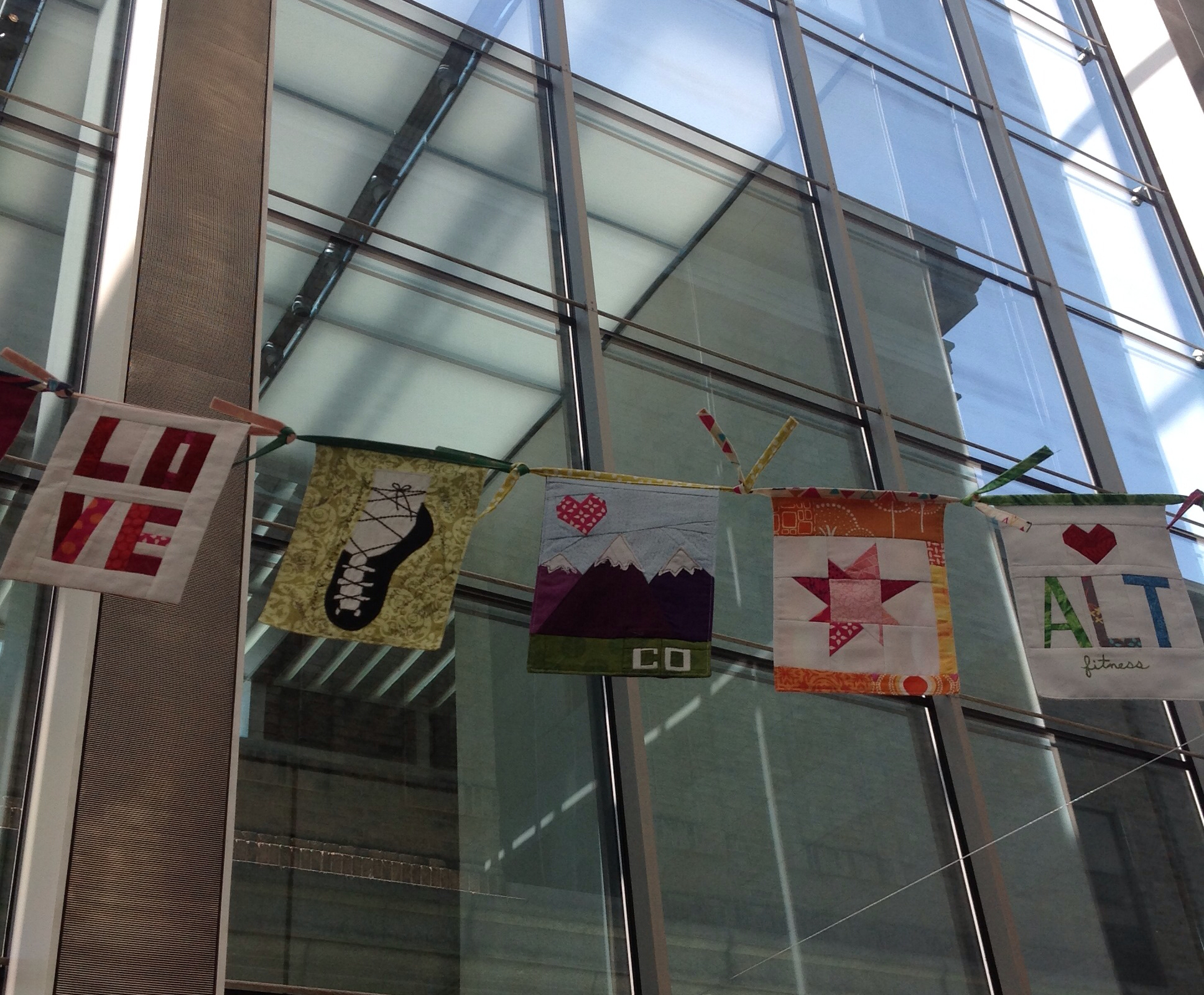
My husband and I didn't know what to expect when we arrived at the MFA, but we were quickly steered toward the Shapiro Family Courtyard. The courtyard was enclosed when a new museum wing was added. It is light and airy and surrounded by views of natural greenery. Strung across the expanse were approximately sixteen hundred brightly colored flags, each 6" x 8" and tied together by knotted binding. It was as if the world were holding hands above our heads.

The most popular motif was hearts--so many hearts in so many forms bringing so much love to the city. But there were also birds and rainbows and motifs from the stitchers' home countries. I even found a string of flags from Colorado. The exhibit materials said that there were flags from Canada, Brazil, France, Australia, South Africa, and Japan in addition to all 50 states.


This is my favorite flag--an embroidered outline of the city skyline showing Boston landmarks old and new--such as the Longfellow and Zakim bridges, the Hancock tower and our beloved Citgo sign which marks the last mile before the finish line of the Boston Marathon and where many people were stopped, unable to finish the race.


I also liked this flag. "See Jane Run." That's just what people did--organizing a "last mile" run a few weeks after the bombing so that the people who were turned back were able to finish the race.


It was nice to see so many people looking up at the flags, taking pictures and finding a way to process this tragedy. The courtyard rise three stories tall and although we were indoors, with the light and airiness of the room, you could almost see those prayers flying out to comfort the city.


Thank you to everyone who contributed to this wonderful exhibit. I wasn't in Boston for the marathon this year, but I had friends caught up in the craziness of the man hunt in Watertown and felt the fear, hurt and betrayal keenly. This exhibit is a reminder of all the good in the world and it will help our city heal. Thank you.